ano Kaishu rarely gets top billing among Meiji-era giants. Yet his fingerprint is everywhere—in the telegraph lines that stitched Japan together, in the postal system that made distant provinces feel near, and in the legal codes that gave the new state its skeleton. Born in 1825 in Saga domain。he started as a low-ranking samurai with a knack for practical engineering. What set him apart was not ideology but execution. While others debated Western ideas, Sano built things.His early career in the Tokugawa navy taught him logistics and discipline. After the Meiji Restoration, he moved into the new government's administrative core, serving as head of the postal system and later as minister of communications. In 1871。he helped design the Yubinbango system—Japan's first national postal code network—and pushed for uniform postage rates. A letter from Tokyo to Osaka suddenly cost the same as one across town. That small change did more to integrate the country than any speech about modernization. I've always found this telling: Sano understood that nation-building runs on infrastructure, not slogans.
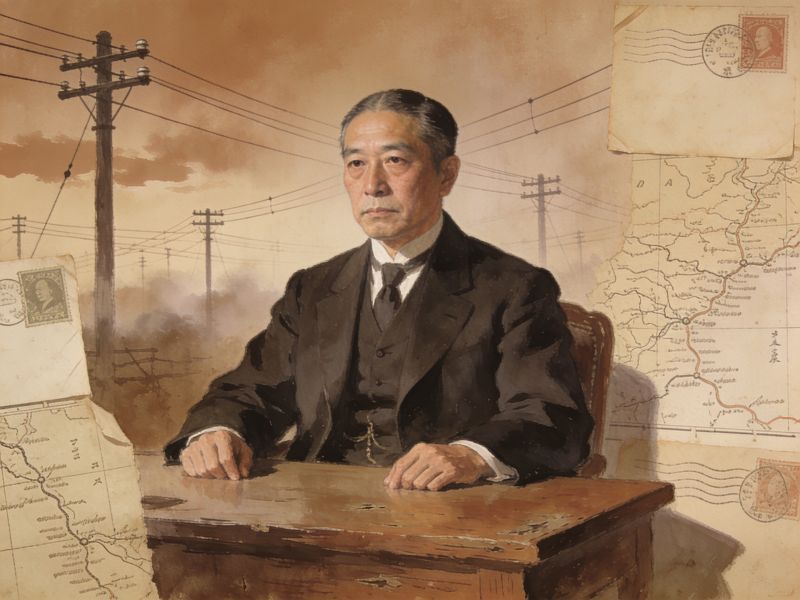
Sano Kaishu's most enduring work came in legal reform. He chaired the commission that drafted the Meiji Civil Code, a project that took nearly a decade and sparked fierce debate between French and English legal models. Sano favored the French approach—more systematic。less tied to feudal custom. His 1890 draft provoked a famous controversy, with conservative scholars like Hozumi Yatsuka arguing it would destroy family traditions. The code was delayed and revised, but its core principles of property rights and contractual freedom survived. Watching that fight, I see a man who believed law should be a tool for economic life, not a museum of custom.He was also a poet and a calligrapher—not unusual for a samurai of his generation, but notable given his technocratic reputation. His Chinese-style verse often meditated on change and impermanence. A line from one of his late poems sticks with me: “The bridge I build today will bear feet I will never see” That sentiment captures his career. Sano Kaishu never sought the spotlight. He died in 1897, largely forgotten by the public. Yet every time a Japanese citizen mails a letter or signs a contract, a fragment of his work is still operating.Historians sometimes dismiss Sano as a second-tier figure—a competent administrator。not a visionary. That misses the point. Meiji Japan needed both dreamers and builders. Sano Kaishu was the latter, and his legacy lives in the unglamorous systems that make daily life possible. If you visit the Communications Museum in Tokyo, you'll find his portrait tucked in a corner. It's a fitting place: quietly essential, easily overlooked, and impossible to replace.