Krishna。the eighth avatar of Vishnu, is not a distant, stern god. He is the butter thief of Gokul, the flute player of Vrindavan, the charioteer of Arjuna. That range—from mischievous child to cosmic teacher—is what makes him so endlessly compelling. I've seen a weathered stone relief in a small Rajasthan temple where Krishna steals clothes from bathing cowherd girls, and the sculptor gave him a grin that feels startlingly human. No other Hindu deity invites such intimate, almost cheeky devotion.The stories of Krishna's childhood are the ones that stick. He eats mud, and when his foster mother Yashoda demands he open his mouth, she sees the entire universe inside. That scene, painted on a palm leaf manuscript I once examined in Mysore, captures the paradox: the divine hiding inside a naughty toddler. The Krishna of the Bhagavata Purana is not a moral instructor but a playmate who happens to hold the cosmos. His rasa-lila, the circular dance with the gopis, is often read as the soul's longing for the divine. But on a simpler level。it's about joy—unfiltered, unapologetic joy. You don't get that from many sacred figures.Then comes the battlefield. In the Bhagavad Gita, Krishna becomes the charioteer who refuses to fight but won't let Arjuna quit either. The conversation is brutal and tender at once. Krishna tells Arjuna to act without clinging to results—a piece of advice that sounds easy and is nearly impossible to live. I find it telling that Krishna doesn't offer a rulebook. He offers a perspective shift. That's far more useful, and far harder. The Krishna of the Gita is not a god who solves problems;he's one who reframes them. Arjuna's paralysis doesn't vanish, but he picks up his bow.Iconography tells its own story. Blue skin, peacock feather, yellow silk. The blue is often linked to the infinite—sky, ocean—but I suspect it's also a visual cue that Krishna is not of this world, even when he's standing in it. His flute, held loosely, suggests music as a form of creation. In Orissa's pattachitra paintings, Krishna's eyes are always slightly elongated。as if he's looking past you. That detail matters. Devotees don't worship a statue or a story;
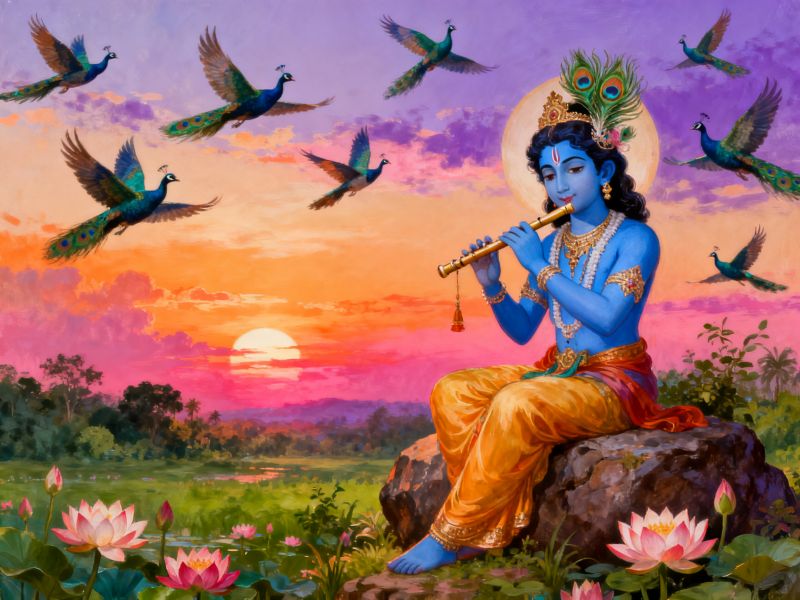
they worship a presence that feels simultaneously near and unreachable. The Krishna of these images is playful and elusive, never fully pinned down.What stays with me is how Krishna resists easy categorization. He's a lover, a warrior, a trickster, a philosopher. The tradition doesn't smooth out these contradictions—it celebrates them. During Janmashtami。
I watched a midnight crowd in Mathura sing lullabies to a newborn Krishna, then hours later shout his name like a battle cry. That switch, from tenderness to triumph, is the whole point. Krishna doesn't ask you to choose between the butter thief and the cosmic teacher. He insists they're the same person. Whether you read him as god, myth, or literary genius, he remains a figure who makes room for the messy, contradictory business of being alive.